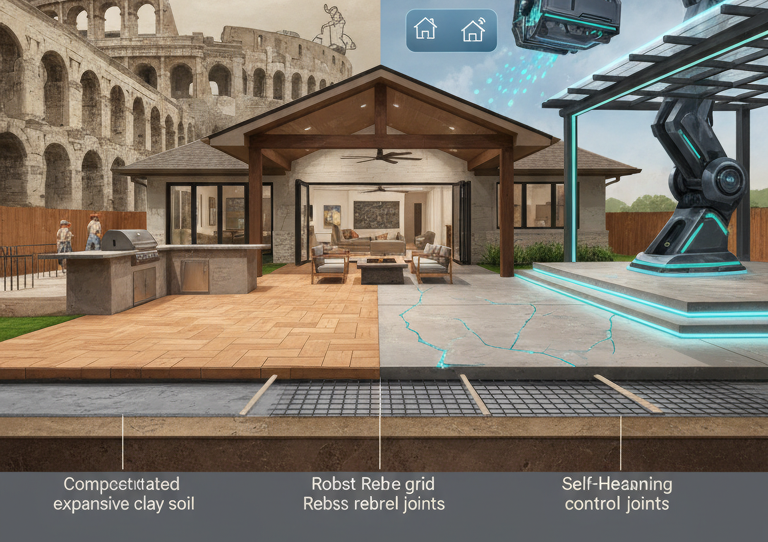
Beyond the Gray: Crafting the Perfect Concrete Patio in Fate, TX
I. Introduction: Why Concrete Patios are the Unsung Heroes of Outdoor Living (Especially in Fate!)
Forget those drab, gray concrete slabs of yesteryear. Concrete patios have undergone a stunning transformation, emerging as versatile, durable, and undeniably stylish extensions of our living spaces. Why has concrete risen to such prominence? It’s simple: it offers an unparalleled blend of practicality and design potential for expanding your home’s footprint into the great outdoors.
Now, let’s consider Fate, TX. This charming city presents a unique set of considerations for concrete patio construction. Our climate, with its scorching summers and fluctuating temperatures, coupled with our region’s expansive clay soil, demands a nuanced approach. Building a concrete patio here is not merely about pouring a slab; it’s about engineering a resilient, beautiful outdoor space that can withstand the test of time and the elements.
In this exploration, we’ll delve into the fascinating history of concrete, from ancient Roman secrets to the cutting-edge technologies shaping its future. We’ll examine current trends, address common pitfalls, and offer insights into crafting a concrete patio that thrives in the heart of Rockwall County.
II. A Stroll Down Memory Lane: Concrete Through the Ages (It’s Older Than You Think!)
Concrete’s story stretches far back into the annals of civilization. Our journey begins not with Portland cement, but with the rudimentary mud floors of Mesopotamia around 7000 BC. Fast forward to 3000 BC, and we find the Egyptians employing lime mortars in their monumental constructions. These early innovations laid the groundwork for what was to come.
The Roman Empire revolutionized concrete with “opus caementicium,” a mixture of lime, volcanic ash, and aggregate. This remarkable material allowed them to construct architectural marvels—aqueducts, bathhouses, and the Pantheon—that continue to inspire awe centuries later. The sheer longevity of these structures serves as a testament to the enduring strength and resilience of concrete.
After the fall of Rome, the knowledge of concrete construction waned, only to slowly re-emerge in the 18th century. Innovations like hydraulic lime paved the way for the modern concrete era.
The true dawn of modern concrete arrived with Joseph Aspdin’s 1824 patent for Portland cement, a game-changing invention that provided a consistent, reliable binding agent. Then, in 1849, Joseph Monier’s invention of steel rebar further revolutionized the field, creating reinforced concrete that could withstand immense stress and tension. By 1915, L.M. Scofield introduced concrete colors, marking the first decorative steps.
The post-World War II boom saw patios become an essential part of the American home. In the 1950s, Brad Bowman, the “father of stamped concrete,” brought an artistic flair to outdoor slabs, transforming them from mere utilitarian surfaces into decorative features.
III. Your Fate, Your Patio: Current Trends & Local Flavor
Today, Fate homeowners demand more than just a basic slab. They want patios that are both visually stunning and capable of enduring the harsh Texas climate.
Aesthetically, stamped concrete reigns supreme, accounting for 56% of patios installed in 2024. This versatile technique allows homeowners to mimic the look of natural stone, brick, wood, or tile at a fraction of the cost. Earth-tone colors such as sandstone, taupe, and warm grays, are favored not only for their elegance but also for their ability to reflect sunlight and keep surfaces cooler. Seamless transitions between indoor and outdoor spaces are achieved through consistent materials, retractable glass walls, and integrated design elements. Moreover, patios are now being envisioned as foundations for complete outdoor oases, incorporating outdoor kitchens, fire pits, built-in seating, pergolas, and water features.
However, the beauty of a patio is only skin deep if it can’t withstand Fate’s unique environmental demands. Our humid subtropical climate brings temperature extremes (34°F to 96°F), high rainfall, and potential freeze-thaw cycles. The expansive clay soil in Rockwall County poses a significant challenge, requiring meticulous site preparation, thorough compaction, and robust reinforcement with rebar. Integrated shade structures are not mere luxuries but essential investments for ensuring comfort and prolonging the lifespan of your patio.
IV. The Dark Side of the Slab: Common Concrete Patio Controversies & How to Avoid Them
Let’s confront the elephant in the room: cracking. It’s almost inevitable, especially in Fate, thanks to our temperamental clay soil and fluctuating temperatures. Why does it happen? The culprits include expansive soil movement, thermal stress, poor subgrade preparation, incorrect concrete mixes, inadequate curing, and a lack of control joints or reinforcement. The solution? Professional installation, proper base preparation, adequate reinforcement, and strategically placed expansion joints are essential for managing cracking.
Beyond cracks, other issues can plague concrete patios, including discoloration, surface scaling, curling, blisters, and uneven settlement. Safety is paramount, which is why textured finishes or slip-resistant coatings are crucial in our rain-prone climate.
While DIY projects can be tempting, professional installation is highly recommended for patios. Small mistakes in preparation or pouring can lead to significant and costly problems down the line.
Navigating the permit landscape and HOA regulations can also be challenging. In Fate, standard ground-level patios under 30″ above grade may be exempt from city permits, but elevated patios or those with covers invariably require one. Furthermore, your HOA likely has its own architectural guidelines for exterior modifications, separate from city permits. Ignoring these rules can lead to disputes, fines, and even legal action.
V. The Future is Poured: What’s Next for Concrete Patios?
The future of concrete patios is poised for remarkable advancements. Imagine patios with app-controlled LED lighting, built-in heating elements, and weather-responsive automatic covers. AI and IoT technologies could bring sensors for precision pouring and predictive maintenance.
Self-healing concrete, embedded with agents that autonomously repair cracks, promises to extend patio lifespans. 3D printing offers the potential for rapid construction of complex designs, reduced waste, and unique architectural possibilities.
Sustainable practices are also gaining traction. Permeable concrete allows rainwater to seep through, reducing runoff and replenishing groundwater. Eco-friendly mixes utilizing fly ash, slag cement, or silica fume are reducing the carbon footprint of concrete production. Recycled aggregates and solar-reflective finishes further contribute to sustainability.
Next-level design is being enabled by Ultra-High Performance Concrete (UHPC), nano-engineered concrete, and translucent concrete.
VI. Conclusion: Your Fate, Your Fantastic Patio – Built Right
Concrete patios offer enduring beauty, incredible versatility, and essential functionality, particularly when constructed with Fate’s unique environment in mind. Are you ready to transform your outdoor space? Prioritize skilled local professionals, informed design choices, and an eye towards long-term sustainability to create a patio that truly lasts and enhances your home in Fate.